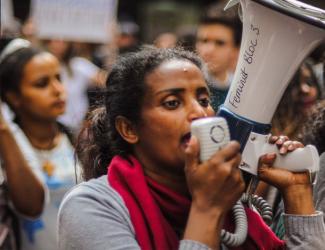
Anit-Racism Movement (ARM) / Flickr (CC BY-NC-ND 2.0)

Priority Areas

Supporting feminist, women’s rights and gender justice movements to thrive, to be a driving force in challenging systems of oppression, and to co-create feminist realities.

Resourcing Feminist Movements

Banner image announcing that WITM Survey is live.


The “Where is the Money?” #WITM survey is now live! Dive in and share your experience with funding your organizing with feminists around the world.

Learn more and take the survey


Around the world, feminist, women’s rights, and allied movements are confronting power and reimagining a politics of liberation. The contributions that fuel this work come in many forms, from financial and political resources to daily acts of resistance and survival.


AWID’s Resourcing Feminist Movements (RFM) Initiative shines a light on the current funding ecosystem, which range from self-generated models of resourcing to more formal funding streams.

Through our research and analysis, we examine how funding practices can better serve our movements. We critically explore the contradictions in “funding” social transformation, especially in the face of increasing political repression, anti-rights agendas, and rising corporate power. Above all, we build collective strategies that support thriving, robust, and resilient movements.


Our Actions

Recognizing the richness of our movements and responding to the current moment, we:

  • Create and amplify alternatives: We amplify funding practices that center activists’ own priorities and engage a diverse range of funders and activists in crafting new, dynamic models  for resourcing feminist movements, particularly in the context of closing civil society space.

  • Build knowledge: We explore, exchange, and strengthen knowledge about how movements are attracting, organizing, and using the resources they need to accomplish meaningful change.

  • Advocate: We work in partnerships, such as the Count Me In! Consortium, to influence funding agendas and open space for feminist movements to be in direct dialogue to shift power and money.

Related Content

هل تقدم جمعية حقوق المرأة في التنمية منح لحضور المنتدى؟

سيقدم صندوق الوصول الخاص بنا عددًا محدودًا من المنح الدراسية لتمويل مشاركة النشطاء/ الناشطات الذين/ اللواتي لا يستطيعون القيام بذلك، وليس لديهم/ن علاقات مع الممولين/ات الذين/ اللواتي يمكنهم/ن تغطية مشاركتهم/ن. لذلك إذا كان لديك احتمالات أخرى، يرجى استكشافها. سنبذل قصارى جهدنا لتقديم أكبر عدد ممكن من المنح الدراسية، وسنشارك المزيد من المعلومات حول هذه العملية وكيفية التقديم لاحقًا في أوائل العام 2024.

Claudia Montserrat Arévalo Alvarado

Biography

Claudia is a feminist psychologist with a Masters degree in Development Equality and Equity. She has been a human rights activist for 30 years, and a women’s rights activist for the last 24.

Claudia works in El Salvador as the co-founder and Executive Director of Asociación Mujeres Transformando. For the past 16 years she has defended labour rights of women working within the textile and garment maquila sector. This includes collaborations to draft legislative bills, public policy proposals and research that aim to improve labour conditions for women workers in this sector. She has worked tirelessly to support organizational strengthening and empowerment of women workers in the textile maquilas and those doing embroidery piece-work from home.

She is an active participant in advocacy efforts at the national, regional and international levels to defend and claim labour rights for the working class in the global South from a feminist, anti-capitalist and anti-patriarchy perspective and class and gender awareness raising. She is a board member with the Spotlight Initiative and its national reference group. She is also part of UN Women’s Civic Society Advisory Group. 

Position
Co-President
Add to stories
Off

Dorothy Masuka

“I didn’t plan to be a singer, singing planned to be in me.” - Dorothy Masuka (interview with Mail & Guardian)

Dorothy Masuka, born 1935 in Bulawayo (then Southern Rhodesia, now Zimbabwe), grew up in South Africa to become a well-known songwriter, composer, jazz singer and activist, a fervent advocate of the struggle against apartheid. Called “an architect of the discourse of popular African liberation music”, Dorothy often sang about politics in indigenous African languages and throughout her work she confronted the racist policies of the South African government.

One such song titled “Dr. Malan” (named after the pro-apartheid politician D.F. Malan) was banned. She went on to record “Lumumba” (1961), a song about the assassination of the anti-colonial leader Patrice Lumumba. Dorothy’s work and activism attracted the attention of the Special Branch of the South African police and she was forced into a political exile that would span over three decades. Throughout this time, she worked with pro-independence groups including the African National Congress. In 1992, as apartheid started to crumble and Nelson Mandela was released from prison, she returned to South Africa. 

Some of her other work includes the first song she recorded in 1953 entitled “Hamba Notsokolo”, a hit in the 1950s and a valued classic. She also wrote “El Yow Phata Phata”, a song that was adapted by Miriam Makeba, making “Pata, Pata” popular internationally.

Rooted in resistance, Dorothy’s music and activism were intertwined, leaving a magnificent and inspiring legacy. She was also widely known as “Auntie Dot”. 

On 23 February 2019 at the age of 83, Dorothy passed away in Johannesburg due to ill health. 


Watch Dorothy Masuka in an interview with Mail & Guardian

Listen to some of her music:

Hamba Nontsokolo
El Yow Phata Phata
 

لقد تقدمت بطلب للمشاركة في المنتدى السابق، هل أحتاج إلى إعادة التقديم؟

نعم من فضلك. لقد تغير العالم منذ عام 2021 ونحن ندعوك لتقديم مقترح يعكس واقعك وأولوياتك الحالية.

Christine Hayhurst

Biography

With over 30 years of finance experience, Christine has devoted her career to furthering nonprofit missions on a global scale. Her contributions extend to serving as Treasurer on the Board of an NGO. Christine joined AWID in 2007 as Controller and in 2023 took on the role as Director of Finance. During her spare time she enjoys traveling, gardening and hiking.

Position
Director of Finance
Add to stories
Off

มีมาตราการอย่างไรในการปกป้องด้านสาธารณสุขและควบคุมการระบาดของโรคโควิด19

เราจับตาดูเรื่องนี้และความเสี่ยงอื่นๆอย่างระมัดระวัง และจะนำเสนอข้อมูลด้านสุขภาพและความปลอดภัยที่คลอบคลุมเมื่อมีการเปิดให้ลงทะเบียน เพื่อให้คุณสามารถตัดสินใจได้อย่างมีข้อมูล มากกว่านั้นการจัดประชุมแบบสองรูปแบบ(ออนไลน์และกายภาพ)ถูกออกแบบให้ให้เกิดการมีส่วนร่วมอย่างมีความหมายสำหรับผู้เข้าร่วมที่เลือกจะไม่เดินทาง หรือผู้เข้าร่วมที่ไม่สามารถเดินทางได้

Who are AWID's members?

A dynamic network of people around the world, AWID members are researchers, academics, students, educators, activists, business people, policy-makers, development practitioners, funders, and more. Our members - of every age - are those who make AWID a unique global feminist association.

Membership with AWID is open to anyone who shares our values

We offer different types of memberships geared to income level and whether you are an individual or an organization. Currently we have over 5000 members, individual and institutional, from 164 countries.

Our members are an important part of our work

We collaborate for advocacy on specific issues, members vote in elections for our Board, and can also participate in and contribute to our Priority Areas through webinars, surveys, or urgent actions, for example.

Our institutional membership draws from a broad range of organizations interested in advancing gender justice and women’s human rights, including women’s rights organizations, from the local to the global levels, grassroots networks, major international institutions, government departments, university programs and more. 63% of our members are from the global South and 38% are under the age of 30.

Learn more about our membership

Snippet CSW68 - AWID at CSW Logo

AWID at CSW68

What is the AWID International Forum?

The AWID international Forum is a gathering of 2,000 women’s rights leaders and activists from around the world. The AWID Forum is the largest recurring event of its kind, and every Forum takes place in a different country in the global South.


The AWID International Forum is both a global community event and a space of radical personal transformation. A one-of-a-kind convening, the Forum brings together feminist, women’s rights, gender justice, LBTQI+ and allied movements, in all our diversity and humanity, to connect, heal and thrive.

When people come together on a global scale, as individuals and movements, we generate a sweeping force.

Join us in Bangkok, Thailand and online in December 2024.

Register now!

Snippet - WITM survey is focused on - EN

The WITM survey is focused on the feminist resourcing realities of the last 3 years (2021 to 2023), and has five key sections:

  1. Group information
  2. Financial status
  3. Shifting power
  4. Sustainability
  5. Key aspirations

It consists of mandatory* and optional questions, most of which are multiple-choice. You will have a chance to share more on issues that are important to you by responding to the open question(s) at the end of the survey.

Hand holding magnifying glass

To respond to the questions quickly and easily, we advise that you have your key financial information at hand (e.g., your annual budgets from 2021 to 2023). However, if you wish to save your responses and come back to the survey later, you are able to do this whenever needed.

March 2015: The Zero-Draft Outcome Document is released

Release of the Zero-Draft Outcome Document, March 2015

  • The zero-draft outcome document (dated 16 March), prepared by the Co-facilitators, was released for discussion at the 2nd drafting session from 13-17 April 2015
  • During the opening session, the WWG on FfD called for dedicated resources for gender equality and women’s empowerment as stated in both the Monterrey Consensus and Doha Declaration,to be added into the Zero draft. 

Snippet - WITM about research - EN

About Where is the Money? research

The global survey is a key pillar of the third iteration of our action-oriented research: “Where is the Money for Feminist Organizing?” (in short, Where is the Money or WITM). The results of the survey will be further elaborated and explored through in-depth conversations with activists and funders and cross-referenced with other existing analysis and research on the state of funding for feminists and gender equality globally. 

The full “Where is the Money for Feminist Organizing” report will be published in 2026.

To learn more how AWID has been shining a light on money for and against feminist movements check out the work of our Resourcing Feminist Movements Initiative here.

What is included in registration fees?

The AWID Forum registration fees for all forum participants cover:

  • Full access to all four days of the Forum
  • Lunches and coffee/tea breaks during forum days
  • Resource materials
  • Simultaneous interpretation during plenaries and some selected breakout sessions/activities (English, French, Spanish, and local language)
  • Participation in the celebration dinner/party
  • Mobile app with final program and chat function
  • Free Wi-Fi service in the forum premises
  • Airport pick ups and hotel-venue-hotel transportation


Our group, organization and/or movement has not taken or mobilized funding from external funders, should we take the survey?

Yes! We recognize and appreciate different reasons why feminists, in their respective contexts, don’t have external funding: from being ineligible to apply for grants and/or receive money from abroad, to relying on resources generated autonomously as a political strategy in its own right. We want to hear from you regardless of your experience with external funding.

Why are you asking for the name of the group, organization and/or movement completing the survey and our contact information?

We are asking for this data to facilitate the review of responses, avoid duplication and be able to contact your group in case you have been unable to complete the questionnaire and/or you have doubts or further questions. You can learn more about how we use the personal information we collect through our work here.

Snippet - WITM why - AR

لماذا عليّ تعبئة الاستطلاع؟